Custom AI Tutor Persona: Build Your Own AI Professor
9 min read
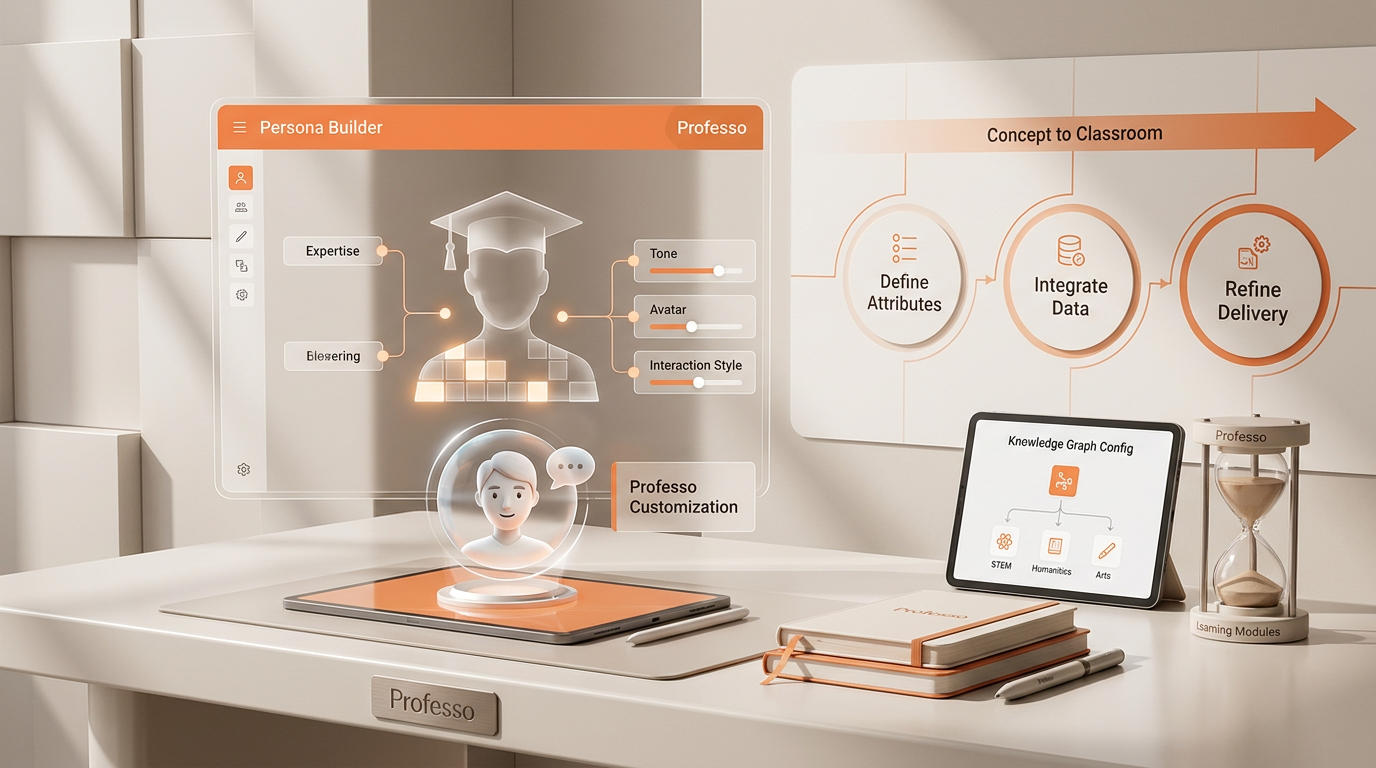
Engineering a custom AI professor persona transforms standard generative models from casual chatbots into rigorous, Socratic learning partners that accelerate concept mastery. By defining strict system instructions, setting up diagnostic feedback loops, and configuring domain-appropriate response rates, students can replicate the high-efficiency learning outcomes seen in advanced EdTech ecosystems. This execution framework replaces passive answer-copying with structured cognitive engagement.
Designing Your Custom AI Persona
Configuring a bespoke AI professor requires an immediate shift from asking for direct answers to scripting strict boundary rules within your model setup. System instructions must establish a non-negotiable persona that prioritizes guidance over solution delivery, forcing active retrieval and critical thinking during every study session.
- Define clear role boundaries and non-negotiable Socratic rules within custom system instructions, explicitly prohibiting the model from outputting direct answers to homework or programming queries.
- Select a subject-appropriate tone profile—such as a rigorous academic mentor or an encouraging technical coach—that aligns with your specific learning objectives and comfort level with friction.
- Calibrate dynamic response granularity and feedback speed to match the cognitive demands of STEM problem-solving or humanities text analysis.
Implementing these parameters ensures that every multi-turn interaction moves the student closer to independent comprehension. A well-engineered persona maintains character stability over dozens of prompts, preventing the AI from sliding back into a helpful assistant mode that simply solves the problem for you.
Why Persona Customization Accelerates Learning
Peer-reviewed learning efficiency research proves that structured AI tutoring significantly alters student performance compared to traditional, unguided study models. A randomized controlled trial published in educational technology literature found that learners paired with an AI tutor completed complex academic tasks in a median of 49 minutes, compared to 60 minutes for students in standard active-learning classrooms source. Furthermore, students utilizing these adaptive configurations scored notably higher on post-assessments, demonstrating that reduced time-on-task does not come at the expense of comprehension.
This empirical efficiency is driving massive adoption across commercial platforms. Khan Academy's AI-powered tutor, Khanmigo, scaled rapidly from 68,000 users during the 2023–24 academic year to over 1.4 million active users by mid-2025 source. Similarly, Duolingo reported that its premium GPT-4-powered tier, Duolingo Max, accounts for 15% of its 47.7 million daily active users source, underscoring a broader market shift toward interactive, persona-driven guidance. These metrics reflect a growing recognition that generic generative prompts fail to capture the cognitive benefits of structured pedagogy.
Standard large language models are optimized for conversational helpfulness, which often manifests as immediate answer-generation that short-circuits deep cognitive processing. Custom system instructions counteract this tendency by transforming the underlying model into an active Socratic tutor. By forcing students to generate hypotheses, justify logic steps, and defend arguments before receiving validation, customized AI personas bridge the gap between raw compute power and evidence-based educational methodology.
Structuring System Prompts and Guardrails
Engineering an effective AI professor persona requires embedding explicit behavioral constraints directly into your platform settings. Without strict guardrails, standard models default to conversational helpfulness, supplying complete code blocks or fully solved calculus derivations that eliminate productive struggle. Your system instructions must establish clear operational boundaries from the very first prompt.
Inject explicit instructions that restrict the model to guided questioning rather than immediate problem-solving, requiring it to respond to queries with targeted counter-questions. Set up diagnostic evaluation rules where the persona verifies student understanding of fundamental prerequisites before advancing to more complex subtopics. Program fallback behaviors so that when a student expresses confusion, the AI drops down a level of abstraction and provides a smaller, digestible hint rather than a full solution.
These guardrails act as architectural constraints that prevent shortcut-seeking behavior. If a student asks for a thesis statement or a sorted array implementation, the prompt architecture forces the AI to reply with a diagnostic prompt, such as asking what data structures the student has considered or what central argument their research supports. This structure enforces active learning loops, ensuring that every session requires genuine cognitive investment from the user.
Selecting Domain-Specific Voice Profiles
| Persona Archetype | Target Subject Domain | Primary Pedagogical Mechanism | Tone & Authority Level |
|---|---|---|---|
| Rigorous Academic | Advanced STEM (Calculus, Physics) | Step-by-step logic validation and error isolation | Crisp, formal, uncompromising precision |
| Socratic Inquirer | Humanities & Social Sciences | Counter-argument generation and primary text analysis | Analytical, probing, neutral inquiry |
| Empathetic Coach | Introductory Coding & Foreign Languages | Micro-step scaffolding and frustration management | Encouraging, patient, highly accessible |
Balancing technical tone parameters requires matching your persona's voice profile to the friction points of your specific subject. For complex sciences, a rigorous academic tone ensures that mathematical notation and logical fallacies are addressed with zero ambiguity. For humanities and analytical writing, a Socratic inquirer archetype challenges underlying assumptions without imposing external biases.
Defining explicit tone triggers allows you to adjust the persona demeanor mid-session based on your immediate study goals. When transitioning from a conceptual breakdown to high-pressure exam prep, your system prompt should instruct the professor to pivot from patient questioning to timed, rigorous interrogation. This dynamic shift ensures the AI remains an appropriate challenge level as your subject mastery evolves.
Calibrate Response Depth and Pace
| Session Phase | STEM Configuration | Humanities Configuration | Context Management Rule |
|---|---|---|---|
| Initial Concept Intro | High brevity; focus on single formulas or definitions | Moderate breadth; establish core theoretical framework | Inject syllabus summary into prompt header |
| Active Problem Solving | Micro-step validation; verify one line of logic at a time | Argument mapping; evaluate single thesis statements | Restrict memory window to last 5 turns |
| Error Correction | Socratic hinting; point to specific calculation flaws | Source citation check; probe logical consistency | Force explicit student restatement of error |
Configuring multi-turn feedback loops is essential for maintaining persona stability and pedagogical efficacy across long study sessions. For STEM subjects, configure micro-step response rates that force the model to evaluate calculations and logic line by line, preventing runaway hallucinations in complex proofs. For humanities subjects, expand macro response breadth to evaluate overarching thesis statements, structural flow, and the integration of primary text evidence.
Maintaining persona stability over extended sessions requires combatting context drift, where models gradually revert to generic assistant behaviors after dozens of turns. Combat this by embedding periodic context refresh instructions within your system prompt, commanding the AI to review its original Socratic guardrails every ten messages. Additionally, keeping response lengths concise prevents the model from overwhelming the student with walls of text that obscure the primary learning objective.
Deploying Custom Personas across LLMs
- Navigate to your user settings in ChatGPT, open the Custom Instructions menu, and paste your structured system prompt into the instructions field to ensure persistence across all new chats.
- For advanced multi-document workflows in Claude, create a dedicated Project, upload your primary texts or syllabus as project knowledge, and inject your professor persona into the system prompt window.
- Establish baseline testing protocols by posing a known problem to your custom persona, verifying that it refuses to give direct answers and instead initiates Socratic questioning.
- Benchmark your custom configuration against out-of-the-box educational platforms like Khanmigo or MagicSchool AI to ensure your personalized prompts offer superior domain-specific depth.
Implementing these steps across commercial language models allows you to tailor the underlying intelligence to your exact academic needs. While dedicated educational tools offer broad out-of-the-box scaffolding, a custom-engineered system prompt gives you absolute control over the persona's tone, disciplinary rigor, and feedback pacing. Regularly audit your deployment by testing edge cases where you intentionally supply incorrect answers to confirm the AI catches and diagnoses the error correctly.
Tailoring Personas for Complex Subjects

Constructing custom personas for demanding technical fields requires specialized prompt adjustments that account for the unique failure modes of generative models. For coding and calculus, build STEM personas that demand step verification, requiring the student to input intermediate outputs before the AI unlocks the next phase of the problem. This prevents the model from hallucinating complex code snippets or skipping critical algebraic steps that obscure the underlying methodology.
Building humanities personas requires configuring prompts that challenge student assumptions with counter-arguments, historical context, and primary text analysis guidelines. Instead of validating an essay outline immediately, the persona should prompt the student to defend their interpretive choices against alternative theoretical frameworks. This approach mirrors the rigor of a university seminar, pushing learners to defend their arguments with textual evidence.
Preventing persona drift during extended multi-prompt sessions is vital for maintaining academic rigor. As a study session stretches past an hour, models naturally dilute their strict instructions unless anchored by repeating constraints. Combat this by embedding hard-coded trigger phrases or structured output formats that require the AI to reaffirm its Socratic stance at the start of every response block.
Iterating Prompts Based on Performance
Auditing your study sessions using task completion speed and retention metrics provides objective data on whether your custom persona is accelerating your learning. If you find yourself spending excessive time unconfusing the AI or arguing against premature answer dumps, your system guardrails are insufficiently strict. Refine your prompt architecture by adding negative constraints that explicitly forbid the behaviors causing friction.
Fix prompt failure modes immediately by tightening the parameters around response length and hint granularity. If the AI is over-explaining concepts before you have attempted retrieval, restrict its output length to a single sentence or a single question per turn. Conversely, if the AI is too cryptic and leaves you entirely deadlocked, program a graduated hint structure that permits clearer guidance after three failed student attempts.
Refining tone parameters and dynamic response rates should be an ongoing process that mirrors your evolving subject mastery. As you transition from an introductory beginner to an advanced practitioner, update your system instructions to reduce encouragement and increase critical rigor. Professo tools simplify this calibration process by allowing users to test, store, and deploy refined prompt templates across different academic disciplines without starting from scratch.
FAQ
- How do I prompt ChatGPT to act like a college professor? You prompt ChatGPT to act like a college professor by writing a detailed system instruction that defines its academic discipline, tone, authority level, and strict refusal to provide direct answers. Your prompt should command the model to adopt the Socratic method, guiding your learning through diagnostic questions rather than immediate problem-solving.
- What custom instructions should I use to make an AI tutor that doesn't just give me the answer? Use custom instructions that explicitly forbid the model from outputting final solutions, completed code blocks, or solved equations until you have successfully justified each intermediate step. Instruct the AI to respond to all academic queries with targeted counter-questions, hints, or requests for your working hypothesis.
- How do I set up a Socratic AI tutor persona in ChatGPT or Claude? Set up a Socratic AI tutor persona by navigating to custom instructions in ChatGPT or project system prompts in Claude, then pasting a role-definition that mandates guided inquiry. Specify that the AI must evaluate your understanding of prerequisites before advancing topics and must break complex problems down into micro-step verifications.
- Are custom AI tutor prompts better than standard AI prompts for studying? Custom AI tutor prompts outperform standard prompts because they interrupt the model's default tendency to supply immediate answers, forcing the cognitive engagement required for active learning. Research proves that structured AI guidance significantly reduces task completion time while improving retention compared to unguided chatbot usage or traditional study methods.
- How do I build a personalized AI professor for tough subjects like code or calculus? Build a personalized professor for technical subjects by embedding domain-specific validation rules into your system prompt that require line-by-line logic checks and syntax sanity tests. Configure the persona to reject unverified final outputs, forcing you to run calculations or debug code iteratively under its direct supervision.
Next steps
Start Learning Today and deploy these custom system instructions to transform your daily study sessions into high-efficiency, research-backed active learning experiences.