Customizable AI Professor: Voice, Tone & Persona Design
8 min read

A customizable AI professor is an interactive agent configured by voice, tone, pedagogical approach, and grounded course materials. Unlike static video lectures or generic chatbots, dynamic AI professors adapt explanation depth in real time to match student goals. Tailored personas significantly boost engagement, lower learning anxiety, and address individual learning styles across complex subjects.
Traditional educational technology tools present static information and leave comprehension testing to periodic exams. In contrast, a persona-tailored teaching agent mimics the adaptive responsiveness of human office hours. By specifying communication traits, educators move beyond simple Q&A interfaces to build autonomous instructional partners. These agents evaluate learner inputs and modulate their delivery style, transforming abstract course materials into interactive dialogues.
Deploying these agents addresses a core challenge in modern higher education: scaling personalized mentorship. Generative AI is utilized by 86% of educational organizations, marking the highest adoption rate of any sector (Faculty Focus). This widespread institutional integration highlights the necessity of moving beyond basic out-of-the-box chat models toward deliberately architected instructional personas.
Configuring Adaptive Pedagogical Modes
Socratic mode guides students through probing questions to build deep conceptual understanding without handing out direct answers. Direct instruction and scaffolded modes provide clear, step-by-step breakdowns for students during initial skill acquisition. Real-time adaptations allow the agent to shift pedagogical modes dynamically based on live student performance and confidence.
| Pedagogical Mode | Primary Teaching Strategy | Best Used For |
|---|---|---|
| Socratic Probing | Guiding via counter-questions and hints | Advanced conceptual synthesis and critical thinking |
| Direct Instruction | Delivering structured, sequential explanations | Introducing novel terminology and foundational rules |
| Scaffolded Support | Breaking complex problems into manageable micro-steps | Debugging code, solving multi-variable equations |
Instructors configure these modes to trigger automatically under specific conditions. If a student signals low confidence or repeatedly fails to answer a conceptual check, the AI shifts from Socratic probing to scaffolded support. Conversely, when a learner demonstrates mastery of basic definitions, the persona transitions into an inquiry-based debate partner. This dynamic shift ensures the learning environment remains challenging yet accessible, preventing both frustration and boredom.
Designing Persona Mechanics and Identity

System prompt engineering sets specific persona parameters, moving from formal academic delivery to encouraging, patient coaching. Pedagogical guardrails prevent direct answer dumping while ensuring empathetic, non-judgmental support during challenging topics. Voice and tone calibration lowers academic anxiety by matching communication styles to student preferences and emotional cues.
Building an effective persona requires defining constraints that govern how the agent speaks and reacts. Faculty specify vocabulary ranges, emotional warmth levels, and behavioral boundaries. For instance, an organic chemistry tutor persona might be configured to use encouraging reinforcement alongside precise chemical nomenclature.
Pedagogical guardrails are essential for maintaining academic integrity. Instructors program system instructions that explicitly prohibit the AI from solving assigned homework problems outright. Instead, the persona guides the student to locate relevant text sections or break the problem into smaller components. This structural design ensures the agent acts as an intellectual catalyst rather than an answer key.
Grounding AI Personas in Course Material
- Ingest course syllabi, lecture slide decks, and primary textbooks into a retrieval-augmented generation (RAG) knowledge base.
- Bound response parameters so the AI professor directly references specific course modules, assigned readings, and rubrics.
- Update knowledge repositories dynamically throughout the academic term as lecture materials and assignments evolve.
Technical grounding eliminates hallucinations and ensures the AI teaches according to the instructor's exact curriculum. When a student asks a question about a specific lecture topic, the retrieval system scans the uploaded slide decks and textbook chapters. The AI then constructs an answer citing the exact week and reading assignment where the concept was introduced.
Maintaining this knowledge base requires periodic maintenance by instructional teams. As new problem sets or updated lecture notes are published, administrators upload them to the repository. This guarantees that the custom AI professor remains synchronized with the syllabus, avoiding contradictions between external internet data and course expectations.
Supporting Neurodiverse Learners and Anxiety
Customizable explanation depth lets neurodivergent learners select chunked text, multi-modal outputs, or step-by-step simplifications. Judgment-free, repeatable interactions create a safe environment for students hesitant to ask clarifying questions in public lectures. Live visual aids and real-time interruption capabilities reinforce working memory and conceptual processing.
- Adjustable Information Chunking: Students overwhelmed by dense paragraphs can request bite-sized summaries or bulleted conceptual breakdowns.
- Asynchronous Pacing: Learners who process information at varying speeds control the conversational rhythm without feeling rushed by a classroom lecture schedule.
- Anxiety Mitigation: Private, patient dialogue removes the social friction and fear of judgment often associated with asking foundational questions in crowded lecture halls.
American students using AI-powered teaching software experienced a 62% rise in test results by diagnosing knowledge deficits early (Faculty Focus). This performance gain stems largely from the elimination of cognitive fatigue and anxiety. When neurodiverse students interact with a predictable, empathetic persona, working memory is freed from social stressors and redirected toward academic comprehension.
Enabling Real-Time Interaction and Interruptions
Real-time dynamic interaction allows students to interrupt mid-explanation for instant clarification or alternate analogies. Integrated live whiteboard teaching transforms abstract concepts in fields like quantum physics into clear visual models. Immediate clarification loops close knowledge deficits up to 62% faster than passive media consumption.
Traditional video lectures force students to pause, take notes, and hold questions until office hours. Platforms featuring voice interaction and live whiteboard rendering alter this dynamic. If an explanation of cellular respiration introduces an unfamiliar term, the student interrupts immediately to request a simplified analogy.
This responsive loop keeps cognitive momentum intact. Rather than losing track of a complex derivation, the learner receives an on-the-spot clarification tailored to their current mental model. The AI immediately adjusts its vocabulary, verifies understanding with a quick check, and resumes the lesson seamlessly.
Analyzing Institutional Deployment Models
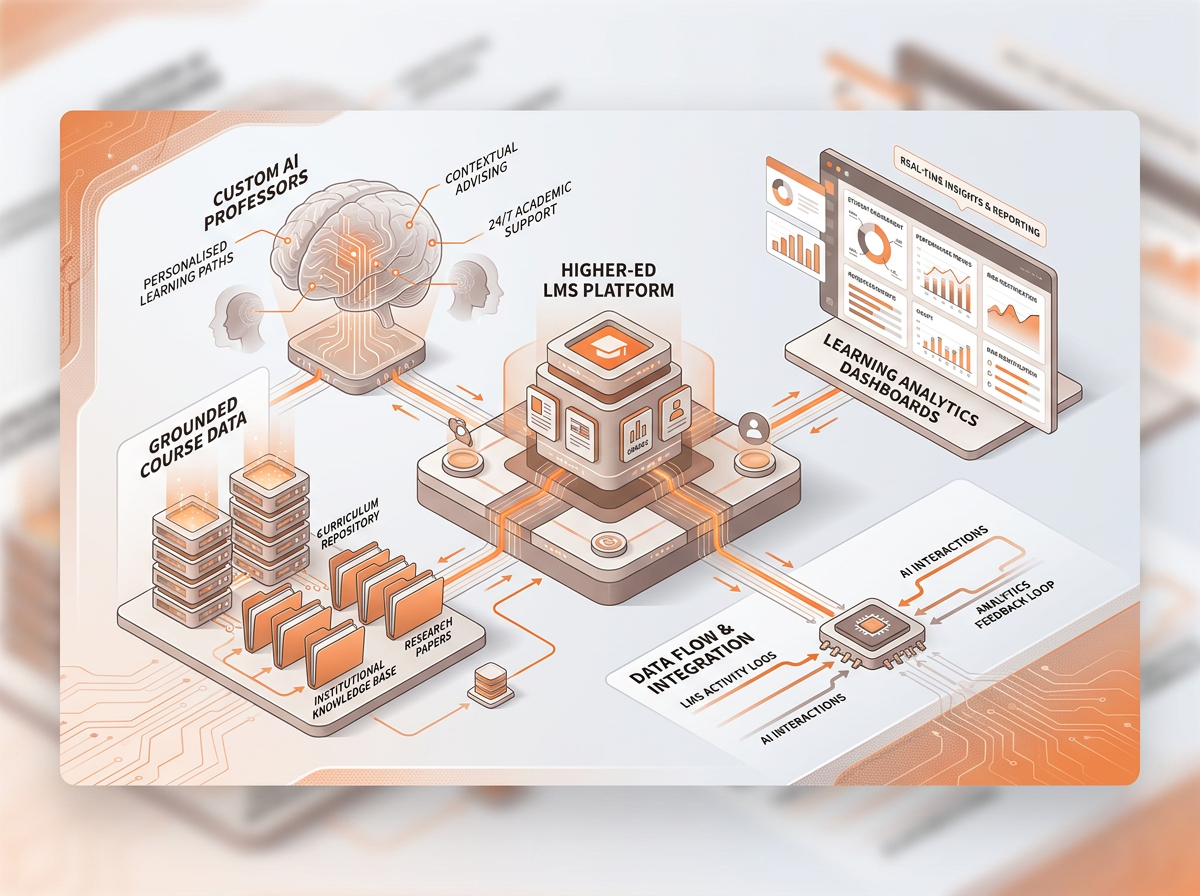
Platforms like Cogniti and Elmhurst's Professor Network illustrate enterprise deployments of branded, course-tailored AI agents. Institutional frameworks balance enterprise data security, LMS integration, and administrative prompt management. Custom institutional branding reinforces trust and aligns AI professor personas with institutional learning objectives.
| Platform / Initiative | Core Deployment Focus | Integration Layer |
|---|---|---|
| University of Sydney (Cogniti) | Multi-agent course environments and secure workspace sharing | Enterprise LMS and single sign-on |
| Elmhurst University (Professor Network) | Branded pedagogical assistants across undergraduate departments | Campus directory and identity management |
Deploying these systems at scale requires rigorous alignment between IT security and instructional design. Universities establish centralized governance models to ensure data privacy regulations are met while giving faculty autonomy over persona traits. By maintaining strict control over API access and prompt repositories, institutions protect student data while scaling personalized instruction across entire academic departments.
Measuring Student Engagement and Impact
Diagnostic tracking identifies student knowledge gaps early before high-stakes assessments or exam cycles. Engagement metrics measure student interaction frequency, session duration, and self-reported subject mastery. Automating routine tutoring through tailored AI agents reclaims roughly 7 hours per week for educators while maintaining academic oversight.
Faculty evaluate the effectiveness of deployed personas by analyzing interaction logs and diagnostic completion rates. These metrics highlight which course modules generate the highest student confusion, allowing instructors to refine subsequent lectures. Furthermore, tracking session duration and question frequency reveals whether students are engaging in deep conceptual exploration or merely seeking quick shortcuts.
Teachers using tailored instruction tools report reclaiming roughly 7 hours per week in content creation and grading (Edutopia). Platforms like Professo allow educators to redirect this time toward complex student mentorship and curriculum design. Measuring engagement ensures that automation serves pedagogical goals rather than replacing human oversight.
Building a Custom AI Strategy
- Identify target courses and map specific learning friction points that require tailored persona support.
- Configure system prompts, tone controls, and RAG knowledge bases on live interaction platforms like Professo.
- Pilot personas with student cohorts, evaluate feedback on tone and teaching style, and iteratively refine pedagogical rules.
Successful deployment begins with a thorough audit of current curriculum bottlenecks. Instructors pinpoint units where failure rates peak or students consistently struggle with foundational concepts. These friction points dictate whether the custom AI professor should emphasize Socratic inquiry or step-by-step direct instruction.
Once the pedagogical strategy is established, faculty configure the persona's voice parameters and upload foundational readings. Piloting the agent with a small student cohort provides critical qualitative data regarding tone, empathy, and clarity. Iterative refinement of these system prompts ensures the resulting AI teaching partner reliably supports diverse learners throughout the term.
FAQ
- How do I prompt an AI to act like a Socratic professor? You prompt an AI to act in a Socratic mode by including explicit system instructions that forbid it from providing direct answers. Instruct the model to respond to student questions with guiding counter-questions, hints, and conceptual prompts that encourage independent critical thinking.
- Can I upload my course syllabus to train a custom AI professor? Yes, educators upload syllabi, lecture slides, and assigned textbooks directly into retrieval-augmented generation knowledge bases. This technical grounding ensures the AI references only verified course materials and avoids generating inaccurate or out-of-scope information.
- What is the difference between a standard AI chatbot and a custom AI professor? A standard chatbot provides generic, unvetted information from broad internet training data without pedagogical guardrails. A custom AI professor utilizes targeted system prompts, emotional tone calibration, and course-specific RAG grounding to act as a structured instructional partner.
- How does customizing an AI professor's tone help neurodiverse learners? Customizing tone allows educators to configure patient, non-judgmental, and encouraging communication styles that lower academic anxiety. This psychological safety, combined with adjustable explanation depth and chunked text outputs, helps neurodiverse students process complex material without cognitive overload.
Scaling Personalized Higher Education
Deploying persona-tailored AI professors bridges the gap between scalable digital infrastructure and individualized student mentorship. By carefully calibrating voice, emotional tone, pedagogical guardrails, and curriculum grounding, educators build responsive agents that support diverse learning needs without sacrificing academic rigor. To design your first course-aligned teaching agent and begin tailoring pedagogical personas for your students, Start Learning Today.