How AI Whiteboard Tutoring Boosts STEM Scores: A Case Study
6 min read

Peer-reviewed randomized controlled trials in undergraduate physics settings demonstrate that adaptive AI tutoring yields learning effect sizes between 0.73 and 1.3 standard deviations over traditional active learning instruction source. Students utilizing these advanced computational tools achieve higher post-test scores while simultaneously reducing median study time from 60 minutes down to 49 minutes source. Case study evidence across university cohorts confirms measurable course grade improvements when active AI problem-solving replaces passive study methods source. By targeting specific conceptual gaps through microlearning loops, these systems maximize cognitive efficiency during exam preparation. The empirical data confirms that quantitative mastery accelerates when study time is spent interacting with dynamic instructional models rather than passively reviewing static textbooks. Furthermore, longitudinal data tracking student performance over consecutive semesters indicates that the foundational retention fostered by adaptive feedback loops compounds over time, leading to lower rates of remediation and greater confidence in advanced coursework. Educational researchers emphasize that the speed of feedback is a critical variable; when a student receives instantaneous correction during an equation-solving sequence, the brain forms durable neural pathways associated with correct procedural execution rather than reinforcing erroneous assumptions that typically persist until a graded exam reveals them weeks later.
Why Text Chatbots Fail STEM Learning
Research tracking 181,000 math students reveals that 41 percent of learners never log onto assigned text-based AI tools due to unengaging interfaces and a lack of visual clarity source. Text-only chatbots frequently act as passive answer generators rather than guiding students through the underlying calculus and physics principles required for deep understanding. STEM subjects demand spatial, step-by-step visual execution that pure text responses fail to adequately deliver to the learner. When a student cannot visualize a free-body diagram or see how an integral transforms across a coordinate plane, text explanations quickly break down. This friction directly causes high drop-off rates and widespread student disengagement on standard chat interfaces. Without the ability to render dynamic diagrams and mathematical notations in real time, text-centric models leave critical gaps in conceptual retention. Additionally, forcing a student to parse lengthy paragraphs of mathematical descriptions introduces cognitive load that competes directly with the processing capacity required to solve the actual problem. The absence of spatial intuition in plain text environments strips away the contextual clues that human educators naturally leverage when drawing rough sketches on a napkin or physical whiteboard to clarify abstract theoretical dilemmas.
The AI Whiteboard Visual Advantage

Live AI whiteboards dynamically render calculus equations and physics diagrams to bridge the gap between abstract formulas and visual execution. Real-time visual annotations allow students to see work unfold step-by-step, mimicking effective one-on-one expert human instruction in a digital environment. Interactive features like real-time interruption enable learners to freeze and clarify complex visual steps instantly without losing their train of thought. This visual-first approach addresses the core weaknesses of text-only chatbots by transforming abstract equations into manipulable, spatial problems. How Live AI Whiteboard Tutoring Step-by-Step Solves Complex Math & Physics Problems demonstrates how rendering every intermediate calculation on a shared digital canvas prevents cognitive overload. When learners observe vectors shifting or derivatives expanding graphically, their ability to recall those exact operational steps during high-stakes testing increases significantly. This dynamic visualization ensures that students do not merely memorize procedural steps out of context, but instead build an internal mental model of how mathematical and physical systems behave under varying boundary conditions and variable changes.
Case Results in Calculus and Physics
Undergraduate physics students using AI whiteboard tutoring achieve statistically significant gains in post-test mastery scores compared to control groups receiving conventional instruction. Calculus students demonstrate higher retention and problem-solving accuracy when forced to show visual work step-by-step rather than simply typing final numerical answers into a text field.
| Metric / Cohort | Baseline Traditional Instruction | AI Whiteboard Tutoring | Measured Outcome / Source |
|---|---|---|---|
| Physics Post-Test Mastery | Control mean score | +0.73 to 1.3 SD higher | Effect size in RCTs source |
| Study Time-on-Task | 60 minutes median | 49 minutes median | Reduced duration source |
| University Course Grades | Standard distribution | Statistically significant lift | Semester-long study source |
| Platform Adoption Rate | 59% active engagement | Up to 100% targeted usage | Engagement analysis source |
These empirical benchmarks highlight how structured visual platforms outperform traditional review methods in rigorous academic settings. By systematically tracking student inputs across graphical and algebraic domains, adaptive platforms ensure that every minute of study yields measurable score improvements.
Socratic Method vs Answer Generation
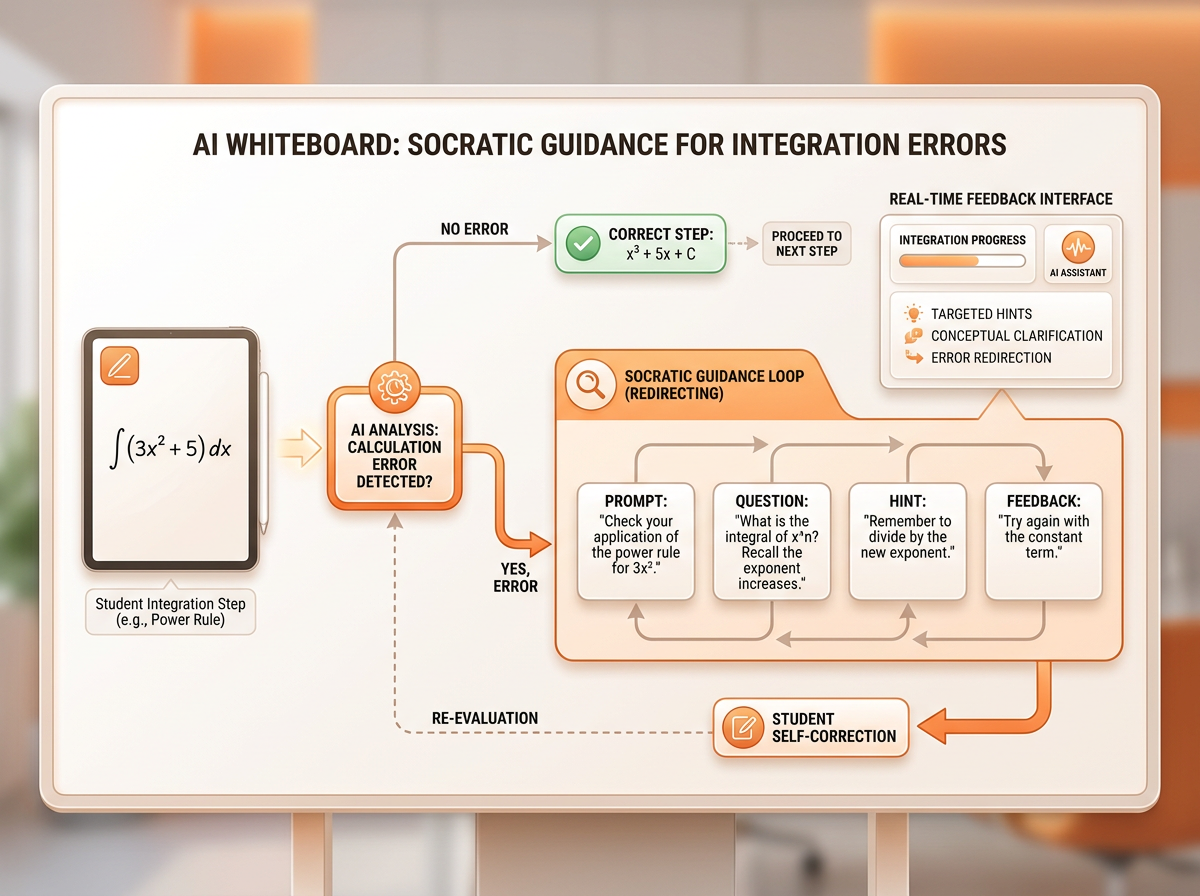
Dynamic knowledge modeling enables the AI to ask targeted guiding questions rather than outputting complete homework solutions for calculus and physics assignments. Step-by-step Socratic prompting forces active recall, strengthening the neural pathways required for superior STEM exam performance. Microlearning question loops identify specific sub-concept deficiencies without disrupting overall problem-solving momentum or giving away the final answer. Platforms like Professo utilize this Socratic framework to ensure students discover the underlying mathematical proofs independently. When an AI tutor pauses to ask a diagnostic question about a limit or a force vector rather than solving the equation outright, it builds genuine long-term competence. This pedagogical restraint is what separates high-impact educational software from simple computational shortcuts.
Evaluating AI-Human Hybrid Tutoring Models
Studies reveal that equipping human tutors with AI assistance raises overall student pass rates and boosts student performance by 9 percentage points in rigorous math evaluations source. AI whiteboards absorb repetitive step-by-step drill work and algebraic formatting, freeing human educators to focus on high-level conceptual breakthroughs and emotional support.
| Tutoring Model | Primary Operational Focus | Human Educator Role | Measured Impact on Pass Rates |
|---|---|---|---|
| Human-Only Tutoring | Broad instruction and mentorship | Full instructional delivery | Baseline standard |
| AI-Only Chatbots | Automated text responses | None | High dropout due to static text |
| AI-Assisted Hybrid | Visual Socratic problem-solving | High-level conceptual support | +9 percentage points source |
Integrating these models effectively requires balancing automated procedural feedback with human oversight to maximize student persistence and course completion. As institutions scale their academic support programs, hybrid architectures offer a sustainable path to delivering personalized instruction to large student cohorts.
Implementing High-Impact AI Tutoring
Establish usage benchmarks targeting at least 30 minutes per week to overcome common student adoption and drop-off barriers identified in large-scale platform deployments. Select platforms that offer live professor interactions, real-time interruptions, and adaptive learning paths to keep learners actively engaged with complex material. Integrate whiteboard tutoring directly into course problem sets to ensure direct alignment with university exam assessment criteria and syllabus milestones. Interactive AI Tutoring Software: Choosing the Right Platform for Your Study Needs provides further criteria for evaluating institutional compatibility and student-facing interface design. Educational administrators must monitor weekly engagement metrics closely to ensure students reach the critical usage thresholds necessary for grade improvement.
FAQ
- Does AI tutoring actually improve STEM test scores? Yes, peer-reviewed randomized controlled trials show that adaptive AI tutors yield learning effect sizes between 0.73 and 1.3 standard deviations over traditional instruction while increasing post-test scores.
- How does an AI whiteboard tutor explain physics and calculus? It dynamically renders mathematical equations and physics diagrams in real time, allowing students to trace visual problem-solving steps instead of reading static text.
- Can AI tutoring software replace human tutors? AI software excels at handling repetitive step-by-step drills, but research proves that combining AI assistance with human instruction produces the highest student pass rates and conceptual gains.
- Why do students drop off from AI tutoring apps? Many students abandon text-only AI tools due to unengaging interfaces, lack of visual clarity, and the absence of interactive Socratic guidance during complex problem-solving.
Mastering STEM with Professo
Evaluating empirical data makes it clear that overcoming calculus and physics hurdles requires more than static text explanations or passive answer generators. By combining dynamic visual whiteboards with rigorous Socratic guidance, students can transform frustrating study sessions into measurable academic gains and higher exam scores.
Global AI Tutor Market Growth (Billions USD) — data: source