How to Use AI for Exam Prep with Active Recall Strategies
6 min read
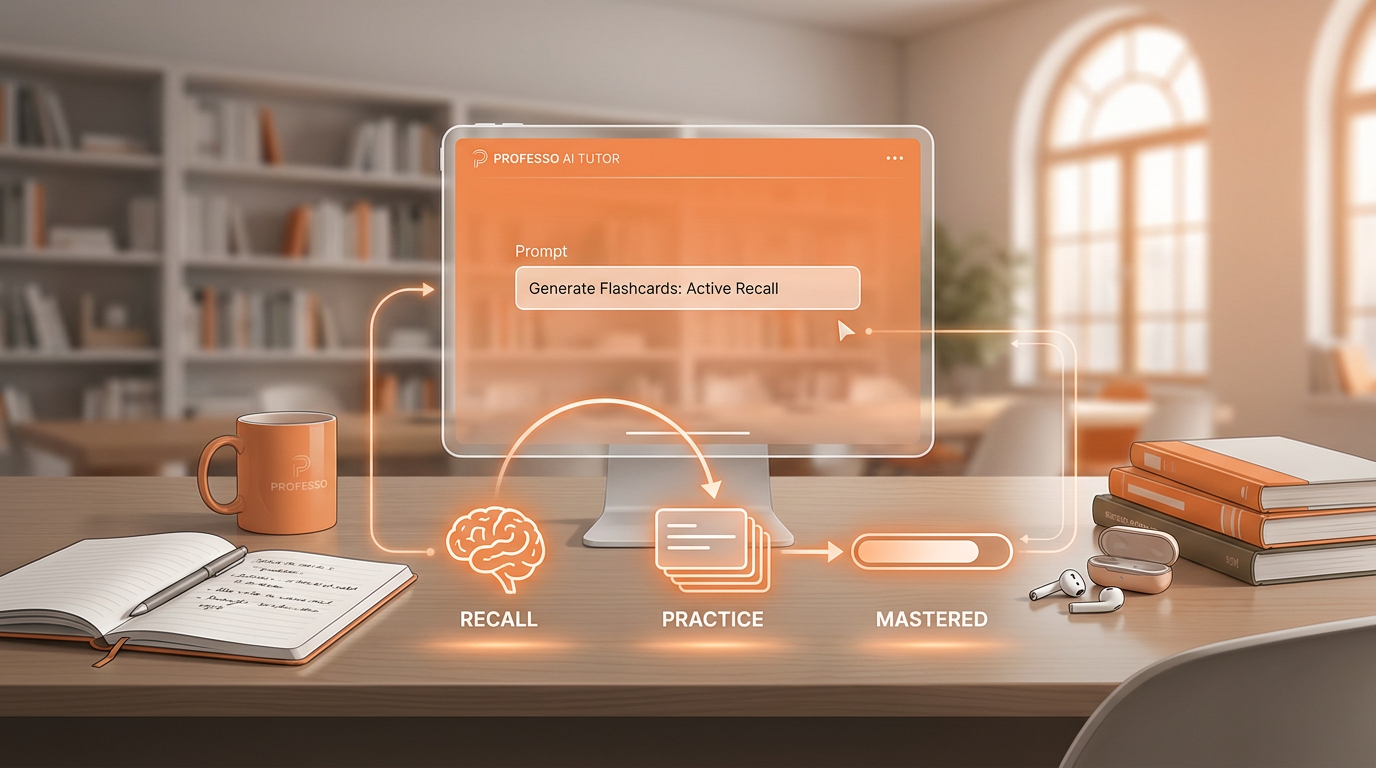
Interactive AI tutors transform passive review into active retrieval by generating dynamic questions rather than summarizing text. Instead of relying on traditional study notes or review sheets that encourage skimming, students can engage with intelligent systems that challenge their comprehension in real time. According to the Stanford HAI 2026 AI Index Report, 80% of university students now use generative AI tools, highlighting a massive shift toward digital study workflows. However, simply asking an AI model to explain a concept often leads to passive consumption and false confidence. Combining source-grounded file uploads with Socratic prompting eliminates hallucination risks and enforces cognitive engagement during high-stakes study blocks. Furthermore, integrating AI quiz output into spaced repetition systems like the FSRS algorithm ensures long-term retention prior to exam day.
Grounding AI in Course Content
Uploading primary materials like lecture slides, syllabi, and PDFs to tools such as NotebookLM or GPT for Drive sets strict knowledge boundaries for the artificial intelligence. This foundational step prevents the underlying model from pulling external, unverified information into your study session. Instruct the model to draw test questions strictly from the provided text to prevent factual hallucinations and ensure alignment with course objectives. Use custom instructions in platforms featuring dedicated options like ChatGPT Study Mode to reject out-of-scope inquiries and maintain absolute focus on the syllabus. When the model is forced to source its questions from your exact lecture transcripts, the resulting practice tests mirror the specific rigor and vocabulary of your professor.
Executing Question-First Socratic Prompting
 Implementing the Question-First framework shifts the AI's role from an answer-dispenser to a rigorous academic examiner. Rather than prompting the engine for summaries, command the AI to act as a strict examiner asking one question at a time. This method prevents cognitive overload and forces the student to retrieve answers independently before seeing any feedback.
- Command the AI Examiner: Instruct the model to ask a single, highly specific conceptual question based on your uploaded notes and wait for your typed response.
- Enforce Step-by-Step Reasoning: Require the model to evaluate student reasoning step-by-step, targeting root conceptual misconceptions to create desirable difficulty.
- Deploy Progressive Hints: Require the AI to deliver progressive hints upon wrong answers rather than immediately revealing full solutions or correct answers.
Building Spaced Repetition Export Systems
Tag concepts missed during interactive AI sessions for immediate conversion into flashcards to close learning gaps permanently. Format AI response outputs directly into Anki-compatible CSV tables using the FSRS algorithm standard for optimal review scheduling. Schedule daily flashcard reviews alongside weekly interactive AI tutor re-testing sessions to balance short-term retrieval with long-term memory consolidation. When an AI tutor identifies a conceptual weakness during a Socratic question loop, export that specific query and explanation directly into your spaced repetition queue. This workflow connects active, generative testing directly with algorithmic review intervals, preventing the forgetting curve from eroding your study gains.
Simulating Timed and Oral Exams
 Use voice-enabled interactive AI tools to conduct simulated oral exams and verbal explanations to reduce test anxiety before final assessments. Set strict time constraints and ask the AI to grade responses based on university scoring rubrics uploaded into the system context. Request post-simulation diagnostic reports identifying specific sub-topics requiring targeted re-study across subsequent preparation blocks. A randomized controlled study by researchers at Stanford University found that utilizing a generative AI assistant tool during live tutoring sessions enhanced students' math performance and boosted tutor capacity to guide complex problem-solving. Practicing under simulated examination conditions conditions your brain to retrieve knowledge under stress, mirroring the exact pressure of a physical lecture hall.
Comparing Interactive AI Tutor Tools
Selecting the optimal platform depends heavily on the academic discipline and the specific study task you need to complete. Broad conversational models excel at general synthesis, while specialized study applications offer dedicated active recall features, file grounding, and live multimodal interaction.
| Tool Category | Primary Platforms | Core Exam Prep Strengths | Best Used For |
|---|---|---|---|
| Source-Grounded Notebooks | NotebookLM, GPT for Drive | Deep PDF parsing, citation tracking, slide querying | Dense reading lists and exhaustive lecture notes |
| Interactive Study Suites | StudyFetch, Khanmigo | Flashcard generation, structured practice exams, whiteboard integration | STEM problem-solving and homework assistance |
| Conversational Engines | ChatGPT (Study Mode), Claude | Socratic dialogue, custom roleplay, oral exam simulation | Conceptual debate and essay structuring |
Evaluating tools based on source-grounded capabilities, active recall features, and live interaction helps students match subject complexity to the right software. For instance, utilize live whiteboard feedback platforms for complex mathematical derivations, while reserving source-grounded text engines for dense literature reviews.
Optimizing Learning Paths for Courses
Break broad course syllabi into progressive, multi-week active recall modules to maintain steady momentum throughout the semester. Adjust AI tutor difficulty dynamically based on real-time accuracy scoring during practice blocks to ensure you are constantly challenged at the edge of your ability. Students can consult resources covering How to Create Personalized AI Learning Paths for K-12 and College Courses to structure progressive study schedules tailored to demanding academic timelines. Furthermore, learners should evaluate platform capabilities by exploring guides on 7 Key Features to Look For in a 24/7 AI Homework Helper to ensure their chosen tool supports robust active retrieval rather than passive answer-seeking. Link study milestones directly to external frameworks to keep your daily preparation aligned with overarching course objectives.
Preventing Hallucinations and Bad Feedback
Audit AI flashcards and practice test keys against recommended primary textbooks before committing large volumes of material to memory. Cross-reference AI explanations with trusted academic resources when handling complex mathematical derivations or nuanced historical claims. Avoid relying on ungrounded conversational prompts that reward articulate but factually incorrect student answers with praise. Data compiled by National University reveals that 77% of consumer devices utilize AI features, but many users accept system outputs without verification. Maintaining rigorous quality control over your AI-generated study materials ensures that false mastery does not undermine your performance on exam day.
FAQ
How do I prompt ChatGPT to quiz me instead of giving answers?
Instruct ChatGPT to adopt a strict Socratic persona by typing a prompt like: "Act as my academic examiner. Do not give me answers. Ask me one conceptual question at a time based on my uploaded notes, wait for my response, and provide hints only if I struggle."
What is the best AI tool to turn lecture slides into practice exams?
NotebookLM and StudyFetch are the leading platforms for transforming slide decks and PDF syllabi into targeted practice examinations. Both tools allow you to upload primary course documents and generate source-grounded quizzes that reflect your professor's exact material.
How can I use NotebookLM to study for final exams?
Upload your complete semester of lecture transcripts, reading assignments, and study guides into a dedicated NotebookLM notebook to create a closed-loop knowledge base. Use the built-in guide generation features to produce study guides, briefing documents, and custom practice questions restricted entirely to your uploaded files.
Does using AI for active recall work better than traditional flashcards?
AI-powered active recall generally outperforms static flashcards because intelligent tutors can dynamically generate follow-up questions, adapt to your specific misconceptions, and provide conversational hints. While traditional flashcards test binary memory, interactive AI tutors test deep conceptual understanding through dialogue.
How do I stop AI tutors from giving wrong test answers?
Always anchor your AI tutor to verified primary source documents such as lecture slides, textbooks, and official syllabi before starting a session. Additionally, use explicit negative constraints in your custom instructions, such as commanding the model to refuse unverified external claims and cite the source page for every explanation.
Next steps
To transform your exam preparation from passive reading into high-yield active retrieval, begin by uploading your course materials into a grounded AI environment and setting up your first Socratic questioning session. Start Learning Today