Interactive AI Coding Tutor: Live Voice & Visual Debugging
7 min read
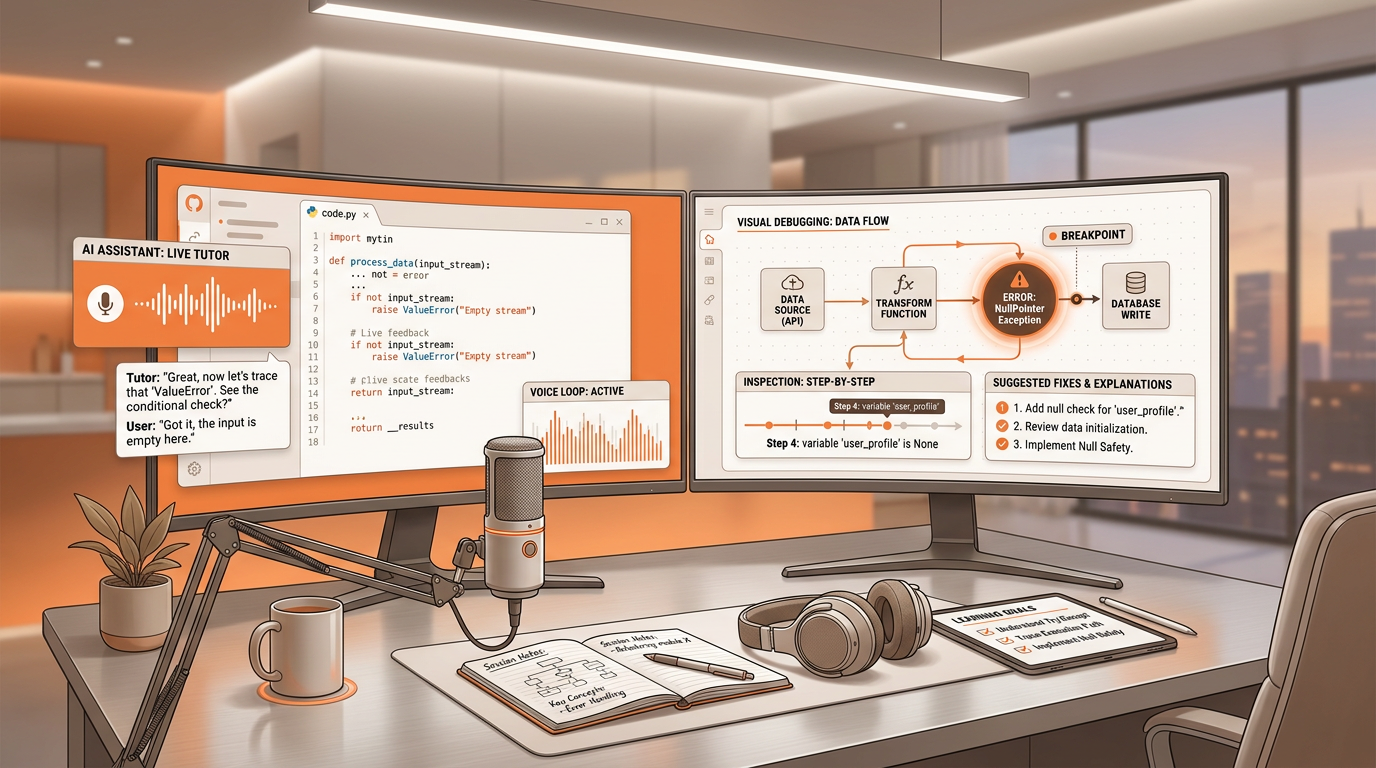
Evaluating an interactive AI coding tutor requires examining whether a platform delivers active spoken dialogue, dynamic canvas diagramming, and Socratic mentorship rather than passive code completion. Traditional developer tooling focuses heavily on text generation and automated execution within an integrated development environment, bypassing the conversational needs of a student learning complex data structures. Professo uniquely integrates live voice conversation, real-time code debugging, and dynamic whiteboard diagramming into a unified learning environment designed specifically for conceptual mastery. By contrast, leading code editors and terminal tools prioritize rapid execution speeds over structured educational dialogue. Effective interactive learning requires multimodal Socratic guidance rather than passive answer generation or text-only autocomplete.
| Capability | Professo | GitHub Copilot | Claude Code | Cursor |
|---|---|---|---|---|
| Primary Design | Multimodal AI Professor | IDE Code Assistant | Terminal-Native Agent | AI-First Text Editor |
| Live Voice Dialogue | Native, low-latency audio | None (Text-only) | None (Text-only) | None (Text-only) |
| Dynamic Diagramming | Real-time whiteboard canvas | None | None | None |
| Debugging Approach | Socratic questioning | Automated line completion | Benchmark task execution | Multi-file text editing |
Leading developer environments optimize for raw code throughput. Educational frameworks require an entirely different architecture centered on live mentorship and visual logic mapping.
Limitations of Traditional Coding IDEs
Developer-focused tools like GitHub Copilot (which commands roughly 42% of the paid coding assistant market with over 4.7 million subscribers) prioritize rapid code generation over step-by-step conceptual mastery GitHub Copilot market share source. These systems excel at predicting the next lines of syntax, which accelerates production workflows for senior engineers but leaves students staring at solutions they did not construct themselves. When a learner struggles to grasp pointer arithmetic or recursive state boundaries, an autocomplete engine simply writes the correct function without explaining the underlying mechanics.
Terminal-native agents like Claude Code excel at benchmarks (reaching 80.8% on SWE-bench Verified and scoring 89.1% on Terminal-Bench 2.1) but function as task executors rather than Socratic mentors Claude Code benchmark source. Anthropic achieved an estimated $2.5 billion annualized run rate by mid-2026 largely due to these developer productivity gains Anthropic revenue source. However, terminal agents operate through text inputs and command-line execution, forcing learners to parse dense error logs and raw diffs. This text-only friction disrupts the cognitive workflow, making it difficult for developing programmers to internalize architectural patterns or debug logical flaws independently.
Core Features of Voice Tutors

Architectural requirements for an effective voice and visual AI learning platform extend far beyond standard chat interfaces or code editors. Building real-time comprehension requires specific technical capabilities that mirror the responsive nature of an expert human instructor.
- Low-latency audio channels that allow immediate verbal interruptions when logic becomes confusing, letting students stop the AI mid-sentence to re-explain a complex algorithm.
- Dynamic visual canvas capability to draw architectural flowcharts, data structure state transitions, and pointer maps in real time alongside the spoken lesson.
- Socratic debugging engine that prompts learners with diagnostic questions instead of supplying complete solutions, forcing the student to reason through edge cases.
- Persistent session memory that tracks previous conceptual roadblocks and adapts future dialogue to reinforce weak foundational topics across multiple study sessions.
These components transform a static software utility into an interactive mentor. Without synchronized audio and visual layers, learners lose the spatial context required to understand abstract programming concepts.
How Professo Enables Live Learning
Professo combines a live voice AI professor with an interactive whiteboard to explain code architecture and draw execution diagrams simultaneously. This multimodal approach bridges the gap between auditory explanation and visual representation, allowing students to hear a breakdown of a sorting algorithm while watching the corresponding pointer swaps populate on a shared canvas. Instead of reading documentation or scrolling through terminal logs, learners engage in a natural, spoken dialogue that feels identical to working alongside a senior developer in a pair-programming session.
Real-time voice interruption capability lets students halt lessons instantly to clarify tricky variables or logical branches without losing their train of thought. If an explanation of asynchronous callback queues becomes ambiguous, the learner speaks up immediately to redirect the professor. Adaptive learning algorithms tailor Socratic questions to individual comprehension levels, replacing $60 to $120 per hour human tutoring with sub-$1 per day AI guidance Human tutoring cost source. This combination of instant availability and personalized inquiry makes advanced software engineering concepts accessible to autodidacts at any stage of their journey.
Voice Workflows in Generic LLMs
Voice modes in ChatGPT Desktop and Claude enable spoken conversation but lack synchronized IDE code execution and dynamic diagramming tools. While these consumer models offer impressive audio fluency, they cannot inspect a shared workspace canvas or draw live state-machine diagrams while talking. A student attempting to debug a recursive function via a standard voice companion must manually describe their code structure verbally, creating a high-friction translation barrier that hinders effective troubleshooting.
Custom prompt setups and voice companion experiments require manual context switching and lack persistent state visualization. Following experiments like Andrew Ng's personal AI voice projects, developers often try configuring general models for tutoring, only to find that unconstrained general LLMs tend to reveal complete code solutions immediately, violating Socratic learning principles. Because these models are optimized to satisfy queries as quickly as possible, they routinely bypass the guided questioning required for genuine skill retention, handing over finished functions rather than teaching the underlying logic.
AI Coding Tutors Versus Humans
Evaluating educational efficacy and economic factors reveals a stark contrast between private human mentors and multimodal AI platforms. Private human coding tutors cost between $60 and $120 per hour and suffer from rigid scheduling constraints, whereas AI professors provide 24/7 instant availability Human tutoring cost source. This accessibility is particularly vital given that parental and adult demand for supplemental academic support remains exceptionally high, with approximately 60% of surveyed households reporting a need for personalized educational resources Parental demand source.
| Metric | Private Human Tutor | Multimodal AI Professor (Professo) |
|---|---|---|
| Hourly Cost | $60 to $120 per hour | Under $1 per day equivalent |
| Availability | Limited by calendar scheduling | 24/7 instant access |
| Pedagogical Method | Varies by instructor experience | Consistent Socratic adaptation |
| Visual Integration | Whiteboard or screen share | Real-time dynamic canvas & voice |
Academic research shows 83% of students rate AI explanations equal or superior to human classroom instructors, achieving higher learning gains in less time AI tutoring study source. Multimodal AI tutoring delivers individual continuous feedback at a fraction of traditional costs, expanding access to top-tier technical education.
Debugging Code with Visual AI
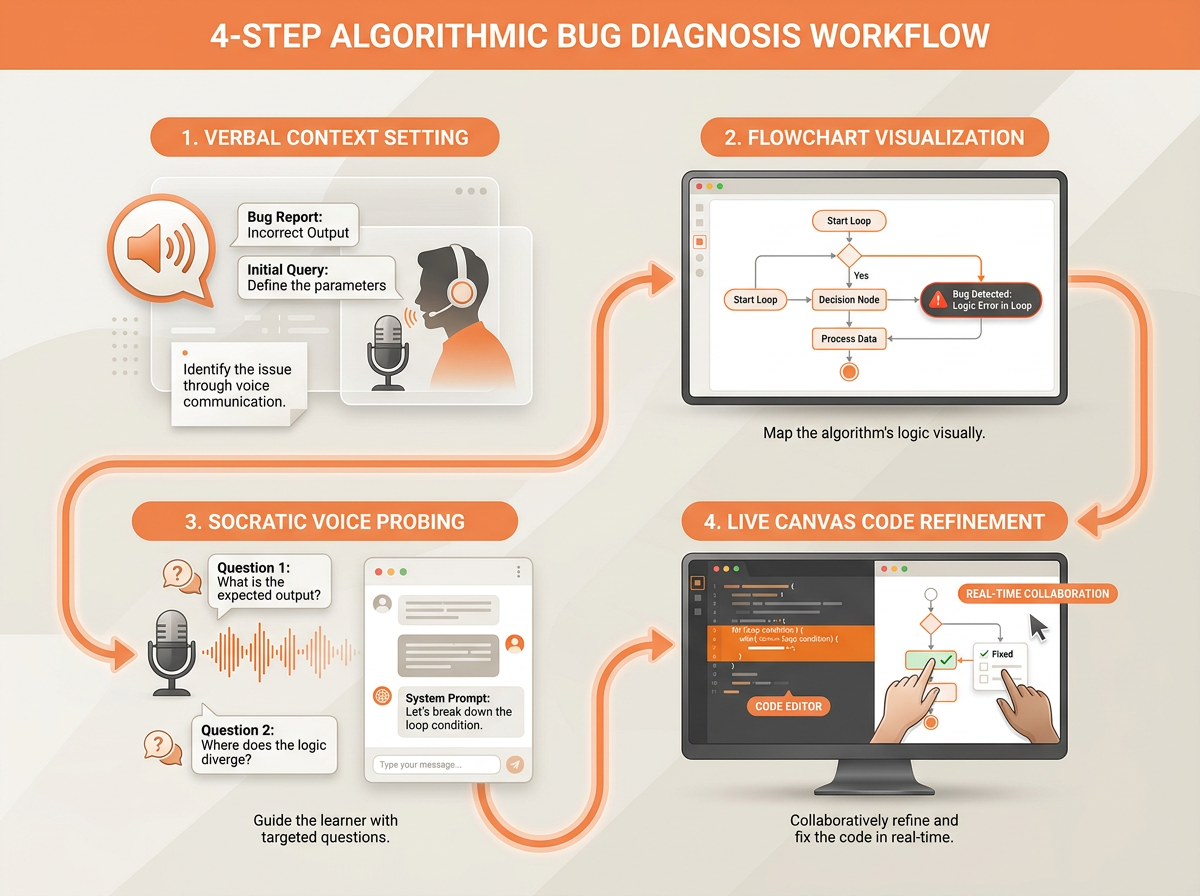
- Explain the program intent verbally while pasting the problematic code snippet into the shared workspace, establishing context for both the audio and text engines.
- Prompt the AI professor to generate a visual flowchart tracing variable state changes and logic paths across execution steps to isolate where the breakdown occurs.
- Engage in Socratic voice dialogue to identify boundary conditions and logical errors without copying raw code fixes into your editor.
- Refactor the code independently based on the visual mapping and diagnostic questions provided during the verbal session, cementing the conceptual fix.
Selecting Your AI Coding Tutor
Choosing the right platform depends entirely on whether your immediate objective is production speed or conceptual skill acquisition. Aligning your tool stack with your current learning phase prevents the frustration of using productivity utilities for education.
- Choose multimodal voice platforms like Professo for initial concept building, algorithm visual modeling, and interactive interview prep where understanding why code works matters more than shipping lines fast.
- Use developer tools like Cursor or GitHub Copilot for high-volume production coding once baseline architecture logic is established and you need to accelerate boilerplate generation.
- Prioritize platforms offering adaptive feedback and Socratic questioning to ensure long-term skill retention over rote memorization.
- Verify that any chosen study tool supports live audio or visual diagramming if you struggle with abstract programming paradigms and require multi-sensory reinforcement.
Selecting purpose-built educational technology ensures that your practice sessions build genuine engineering intuition rather than dependency on automated autocomplete tools.
FAQ
- Which AI coding tutor lets me talk out loud while drawing diagrams? Professo provides a unified interactive environment that combines real-time voice conversation with a dynamic whiteboard canvas for architectural diagramming. While general voice apps allow speaking, they lack the synchronized canvas tools required to map out code execution visually.
- Can Cursor or Claude Code act as a live voice professor? No, developer tools like Cursor and Claude Code are text-based IDE extensions and terminal agents optimized for code execution, file editing, and automated autocomplete. They do not feature live voice dialogue or real-time visual whiteboard instruction.
- How does Professo debug code using dynamic visual flowcharts? Professo analyzes pasted code snippets alongside your spoken description to render step-by-step execution diagrams on an interactive canvas. The AI professor then guides you through those visual states using Socratic questioning rather than writing the fix for you.
- Is an AI voice coding tutor cheaper than hiring a human mentor? Yes, private human coding mentors typically charge between $60 and $120 per hour, whereas multimodal AI tutoring platforms deliver continuous, personalized instruction for under $1 per day. This dramatic cost difference makes 24/7 expert guidance accessible to all learners.
Master Complex Code Architecture
Overcoming challenging programming roadblocks requires moving beyond passive text editors and static autocomplete tools. By pairing live voice conversation with real-time visual diagramming and Socratic mentorship, you can build deep conceptual fluency in a fraction of the time. Start Learning Today