Multilingual AI Tutors for International Students Explained
7 min read

Multilingual AI tutors help international university students master complex higher education coursework by translating dense academic concepts into a student's native language without losing technical rigor. Higher education demands engagement with intricate ideas across STEM, law, and business, creating a severe cognitive gap for non-native English speakers who must process lectures taught in their second language while simultaneously attempting to grasp advanced theoretical frameworks. Traditional translation software breaks down when handling domain-specific jargon, leaving students isolated with poorly translated technical manuals and incomprehensible slide decks. Specialized AI systems bridge this comprehension barrier by providing precise, context-aware translations that respect the underlying academic discipline. Empirical research demonstrates that advanced AI tutoring boosts learning efficacy by up to 1.3 standard deviations while simultaneously reducing required student study time Engageli. By transforming difficult English source material into clear, native-language explanations, these platforms ensure international scholars focus on mastering subject matter rather than decoding syntax. Furthermore, the modern global campus environment relies heavily on fast-paced, multi-channel knowledge transfer that traditional support services cannot adequately scale to meet.
Academic Subject Tutoring vs Basic Language Apps
Consumer language learning applications focus primarily on conversational fluency and general vocabulary, whereas academic AI tutors parse complex higher education coursework. Apps designed for travel or basic vocabulary drills fail when confronted with organic chemistry pathways, corporate tax law, or advanced macroeconomic models. Domain-specific AI tutors maintain rigorous context across legal codes, engineering equations, and advanced domain jargon, ensuring that every technical translation remains academically accurate. Platforms like 10 Best AI Tutors and Professors for Personalized Self-Study in 2025 offer deep curricular alignment that consumer-facing flashcard apps cannot replicate. The fundamental differences in pedagogical design, depth, and syllabus alignment appear in the feature comparison table below.
| Feature / Capability | Consumer Language Apps | Higher Education AI Tutors |
|---|---|---|
| Core Pedagogical Focus | Conversational fluency and travel vocabulary | Complex academic subject mastery (STEM, law, business) |
| Technical Jargon Handling | Superficial or missing | High precision across specialized university disciplines |
| Syllabus Integration | Generic pre-set curriculum | Ingestion of specific course syllabi and lecture slides |
| Interaction Mechanics | Sentence repetition and basic quizzes | Real-time code-switching, dynamic whiteboards, and micro-interventions |
Domain-Specific AI Professors for Higher Education
Multilingual AI professors analyze university-level textbooks and lecture transcripts to construct context-aware explanations tailored to specific degree requirements. When international students encounter dense theoretical frameworks, these specialized systems deconstruct the material into digestible definitions without sacrificing core meaning. Students receive native-language translations of technical terms grounded directly in their course syllabi, eliminating the confusion caused by generic dictionary definitions that mismatch classroom terminology. Platforms like Professo pair live whiteboard visuals with native-language audio to clarify obscure academic concepts during self-study sessions. This focused approach ensures that legal doctrines, mechanical engineering calculations, and financial accounting principles are fully understood regardless of the student's primary language. By aligning directly with institutional standards, these tools prevent the dangerous drift that occurs when students rely on generic third-party web translators that lack structural context.
How Real-Time Code-Switching Clarifies Concepts
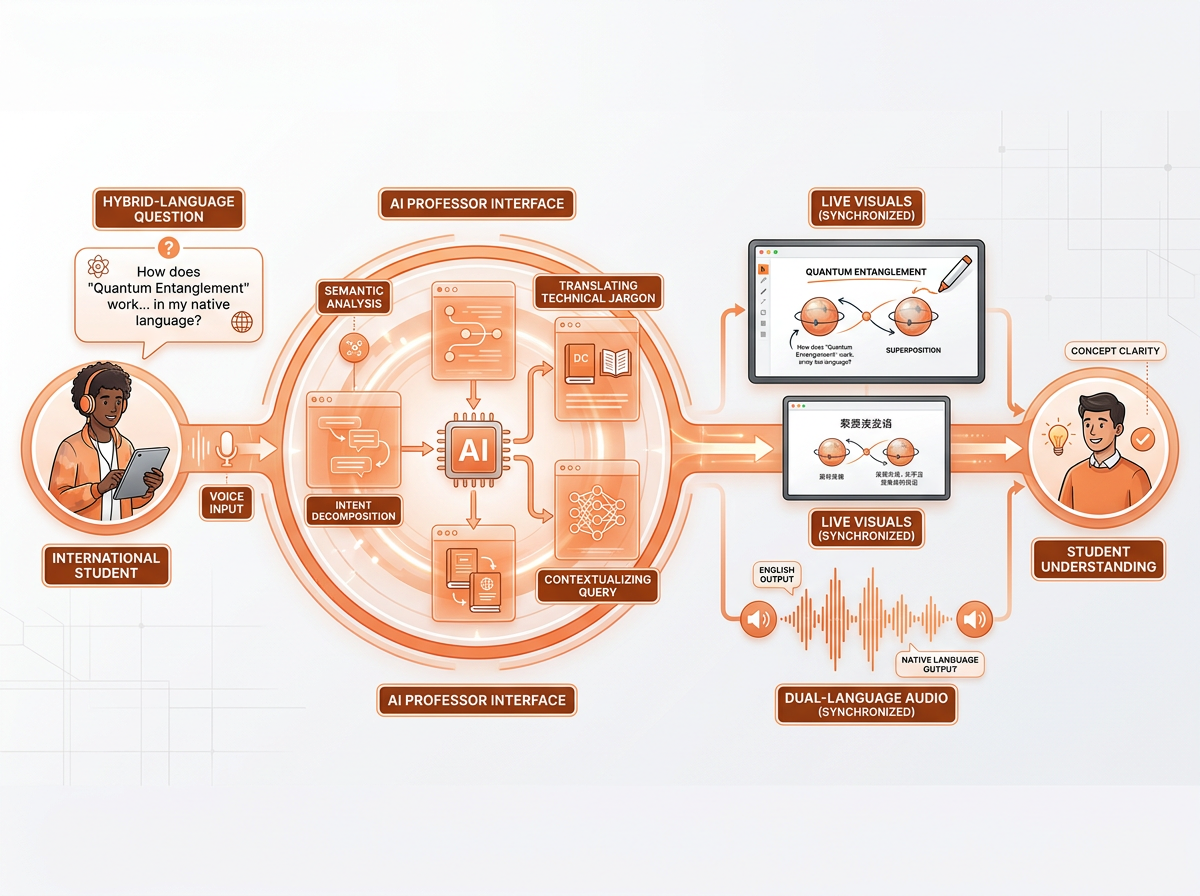
Dynamic code-switching enables non-native speakers to formulate queries in their native tongue while retaining English technical terminology within the same sentence. This fluid bilingual interaction mirrors how multilingual researchers naturally think and communicate in global academic settings. Multimodal interaction combines speech-to-text, live visual whiteboards, and synchronized textual translation to deliver deep comprehensible input. When a student struggles with a difficult theorem, the AI delivers real-time micro-interventions that correct underlying language misunderstandings mid-thought without disrupting academic reasoning. These instant adjustments keep learners inside their optimal zone of proximal development, transforming frustrating study hours into productive conceptual breakthroughs. This seamless linguistic integration removes the cognitive penalty typically paid when students must mentally translate entire paragraphs back and forth between two completely isolated languages during high-pressure study blocks.
Reducing Speaking Anxiety in Higher Education
A private AI interaction space eliminates the fear of peer judgment during high-stakes academic practice for non-native speakers. University seminars often penalize hesitation, making international students reluctant to voice complex arguments or ask clarifying questions in front of native-speaking peers. Students rehearse complex oral arguments and explanations with the AI before contributing to university discussions, building both linguistic competence and professional confidence. Adaptive pacing allows learners to interrupt, pause, and request clarifications whenever comprehension breaks down, ensuring complete mastery before high-stakes assessments. This low-pressure environment significantly accelerates language acquisition while building genuine readiness for active seminar participation. Over time, consistent private rehearsal transforms passive listeners into confident, vocal contributors who can defend their academic viewpoints with clarity and poise.
Syllabus Integration and Dialect Adaptability
AI professors ingest instructor slide decks and reading lists to ensure responses mirror course expectations and grading criteria. Customizing the AI to match a specific professor's terminology prevents conflicting definitions between the classroom lecture and private study materials. Tone adaptation allows switching between formal academic syntax and accessible conversational explanations in regional native dialects, supporting diverse student backgrounds. Students can explore How to Custom-Design Your Own AI Professor Persona for Accelerated Learning to tailor teaching styles to match personal learning preferences and specific degree requirements. Custom persona settings ensure the AI adopts the precise explanatory style that resonates best with the individual learner. Such granular configuration options empower students to curate an entirely bespoke academic support ecosystem that adapts dynamically as their coursework grows progressively harder.
Measuring Impact on GPA and Efficiency
Quantitative data shows that university students utilizing AI tutors frequently experience measurable gains in academic performance and study efficiency. Data from Los Angeles Pacific University shows that students engaging with an AI assistant three or more times achieved an average GPA increase of 7.5% Gray DI. AI-driven comprehensible input reduces required student study time from 60 minutes down to 49 minutes per session while simultaneously improving concept retention Engageli. Furthermore, the global AI tutor market is projected to expand from $2.7 billion in 2026 to $17.7 billion by 2033, growing at a 30.5% CAGR, driven largely by demand for inclusive, multilingual solutions in higher education (Grand View Research). Over 75 percent of global language educators now deploy AI tools to craft personalized academic learning assets, cementing artificial intelligence as a core pillar of modern university support Edumo. These statistics illustrate a sweeping structural transformation in how universities achieve equitable outcomes for international cohorts.
| Metric / Performance Indicator | Traditional Study Methods | Multilingual AI Tutor Integration |
|---|---|---|
| Average Study Session Duration | 60 minutes per study block | 49 minutes per study block Engageli |
| Student GPA Impact | Baseline university average | Average GPA increase of 7.5% Gray DI |
| Learning Efficacy Gain | Traditional active learning | Outperforms baseline by 0.73 to 1.3 standard deviations Engageli |
Strategies for Maximizing AI Professor Benefits

Upload course syllabi and lecture slides to establish context-grounded AI knowledge boundaries before beginning independent study. This initial setup step ensures the AI tutor references exact course definitions rather than generic external definitions that might confuse grading criteria. Leverage live whiteboard features to request immediate native-language micro-interventions during complex reading assignments in advanced STEM or law courses. Practice active recall by explaining key course takeaways back to the AI tutor in both target and native languages to solidify long-term memory consolidation. Maintaining a structured workflow with an AI assistant bridges the gap between language acquisition and academic mastery. By approaching these tools with intentional study strategies, students maximize knowledge retention while minimizing extraneous cognitive load across demanding semesters.
FAQ
- Can a multilingual AI tutor explain university STEM concepts in my native language? Yes, multilingual AI tutors translate and explain advanced STEM concepts, such as organic chemistry pathways or mechanical engineering equations, directly into your native language while retaining required technical terminology.
- How is a multilingual AI professor different from Duolingo or Google Translate? Unlike consumer apps that focus on basic conversational vocabulary or literal translation tools that break down on technical text, academic AI professors parse complex higher education coursework and align directly with course syllabi.
- Will using an AI tutor to translate lectures help lower academic anxiety? Using a private, non-judgmental AI environment allows international students to practice oral arguments and clarify complex points without fear of peer judgment, directly reducing speaking anxiety.
- Can an AI tutor switch between English and my native language during a lesson? Dynamic code-switching allows the AI to move fluently between languages during a single explanation, letting students formulate queries in their native tongue while preserving English technical terms.
- How do multilingual AI tutors handle specialized technical jargon? Specialized academic AI models ingest university textbooks and lecture transcripts to maintain strict context across legal codes, business models, and engineering terminology without diluting academic rigor.
Master Your University Coursework
International university students no longer need to struggle against language barriers while trying to master advanced academic disciplines. By integrating real-time code-switching, syllabus-grounded translations, and domain-specific AI professors into your study routine, you can process complex lectures with complete confidence and clarity. Transform your approach to higher education coursework and accelerate your academic performance with a platform designed specifically for non-native scholars. Start Learning Today to experience the full power of context-aware, multilingual academic tutoring.