Personalized AI Course Creation: Step-by-Step Guide
7 min read

Personalized AI course creation combines diagnostic prompt engineering, sequenced skill roadmaps, hands-on projects, and active feedback loops to build bespoke technical curricula. By replacing one-size-fits-all video libraries with custom-generated instruction, self-directed learners can master complex technical stacks from scratch without relying on traditional pre-recorded syllabi. Tailoring learning paths with generative models yields up to a 60% increase in student engagement and improves overall learning efficiency by 57%, according to data compiled by Engageli. Furthermore, AI-personalized approaches generate a 70% improvement in course completion rates over standard formats (Engageli). While static LLMs draft initial curriculum blueprints, mastering advanced technical skills requires adaptive, real-time interactive teaching platforms like Professo.
Here is the 4-step framework for building your own technical curriculum from scratch:
- Diagnostic Prompting: Input your current baseline, target tech stack, and weekly hour constraints into an LLM to map out realistic goals.
- Competency Sequencing: Request a modular curriculum organized by technical dependencies rather than calendar dates.
- Applied Project Generation: Instruct the model to build hands-on coding scenarios and architecture briefs rather than multiple-choice quizzes.
- Adaptive Feedback Loops: Feed error logs and failed test outputs back into your AI interface to dynamically alter upcoming module difficulty.
Assess Baseline and Set Learning Constraints
Input your current baseline knowledge, explicit career or technical goals, and available study hours per week into a rigorous prompt structure to prevent your AI model from generating unrealistic syllabi. Without precise constraints, large language models default to generic academic pacing that rarely matches an individual self-directed learner's actual schedule. Require the AI model to conduct a diagnostic quiz before finalizing course module difficulty levels, ensuring you skip concepts you already understand. To prevent progress blockers, define exact technical prerequisites required before advancing into complex applied modules like asynchronous API integration or memory management in Rust. Explicitly state your coding background, your preferred programming language, and whether you are starting completely from scratch or transitioning from a related technical discipline. This calibration phase ensures the resulting curriculum matches your precise cognitive load threshold and time availability, establishing a sustainable foundation for long-term technical mastery.
Sequence Competency-Based Weekly Technical Roadmaps

Structure your learning modules by competency dependencies rather than arbitrary calendar dates to ensure foundational logic always precedes practical coding exercises. When designing a curriculum for complex fields like data engineering or backend systems, foundational principles such as relational database normalization must precede distributed pipeline construction. Use explicit prompt variables with advanced reasoning models to enforce granular week-by-week topic breakdowns that explicitly map out prerequisite skills for every milestone. Integrate micro-credentials and skill check-ins at every milestone to maintain learner motivation and prevent the drop-off typical of self-directed study. Traditional massive open online courses suffer from low completion rates ranging between 3% and 15% (median 12.6%), while structured, community-backed or custom-sequenced programs achieve completion rates up to 65.5% as noted by Ruzuku. Organizing your curriculum around strict competency dependencies guarantees that you never encounter a technical roadblock caused by missing foundational knowledge.
Generate Applied Projects and Active Recall
Instruct your AI engines to generate real-world project briefs rather than relying on abstract theoretical exercises that fail to build practical muscle memory. When learning a new technical stack, passive reading of code snippets creates an illusion of competence that shatters the moment you open a blank integrated development environment. Create automated active recall quizzes and code-review prompts to reinforce long-term memory retention across difficult syntax and architectural design patterns. Set up rubric-based evaluation prompts where the AI critiques your submitted code or technical solution architecture against industry production standards. By demanding end-to-end project scenarios—such as building a fully containerized microservice or an automated ETL data pipeline—you force your custom curriculum to mirror real-world engineering challenges. This hands-on approach transitions your study sessions from theoretical consumption to active, production-grade skill execution.
Evaluating AI Course Creation Tools
Choosing the right technological foundation dictates whether your personalized curriculum results in genuine technical mastery or just another folder of unread text documents. The market features a wide spectrum of tools, ranging from static text generators to asynchronous course assembly platforms and real-time adaptive systems.
| Category | Primary Tools | Core Limitations | Best Use Case |
|---|---|---|---|
| Static Prompt Engines | ChatGPT, Claude 3.5 Sonnet, Gemini, NotebookLM | Generate detailed text outlines but lack real-time interactive execution, voice Q&A, and live visual instruction. | Drafting initial curriculum blueprints and querying syntax definitions. |
| Asynchronous Course Builders | Coursebox AI, TutorAI, Khanmigo | Package material into pre-rendered modules or static chat interfaces, remaining limited by rigid structures. | Generating structured multiple-choice quizzes and basic reading modules. |
| Dynamic Adaptive Platforms | Professo | Combines personalized AI curriculum generation with live whiteboard instruction and real-time voice interaction. | End-to-end mastery of complex technical skills through interactive live teaching. |
Static models excel at drafting comprehensive study outlines, but they cannot dynamically whiteboard complex data structures or adjust their teaching cadence mid-sentence based on your facial expressions or verbal confusion. Understanding these architectural differences prevents you from relying on tools built for static content creation when your goal is rigorous, hands-on technical acquisition.
Master Complex Concepts with Professo Live Instruction
Professo acts as a live AI professor that visually demonstrates complex technical concepts and software architecture on an interactive whiteboard, bridging the gap between static text and human tutoring. When you encounter abstract paradigms like asynchronous event loops or cryptographic signing mechanisms, static prompts and text blocks often fail to clarify the underlying mechanics. Learners can interrupt lessons at any moment to request instant clarifications, ensuring zero unaddressed knowledge gaps persist during your study sessions. The curriculum dynamically adapts on the fly during live sessions based on student feedback, adjusting the explanation depth and moving to alternative analogies when comprehension falters. This real-time voice and visual interaction replicates the effectiveness of one-on-one mentorship, transforming isolated self-directed study into an engaging, responsive educational experience.
Build Adaptive Curriculum Refinement Loops
Maintain an error log of missed quiz concepts, compiler errors, and flawed project code to feed back into your AI model for continuous path recalibration. Self-directed learning often fails when learners repeat the same study habits despite repeated failures on specific technical topics. Prompt your AI engine to generate targeted remedial modules focusing specifically on identified weak spots in your error log before advancing to the next weekly milestone. Leverage adaptive algorithms to alter pace and difficulty automatically based on your weekly assessment scores, driving higher completion rates than traditional static formats. By treating your curriculum as an iterative software project—where bugs in your understanding trigger automated refactoring of your study plan—you ensure steady, measurable progress toward absolute technical proficiency.
Execute Your AI Course Creation Workflow
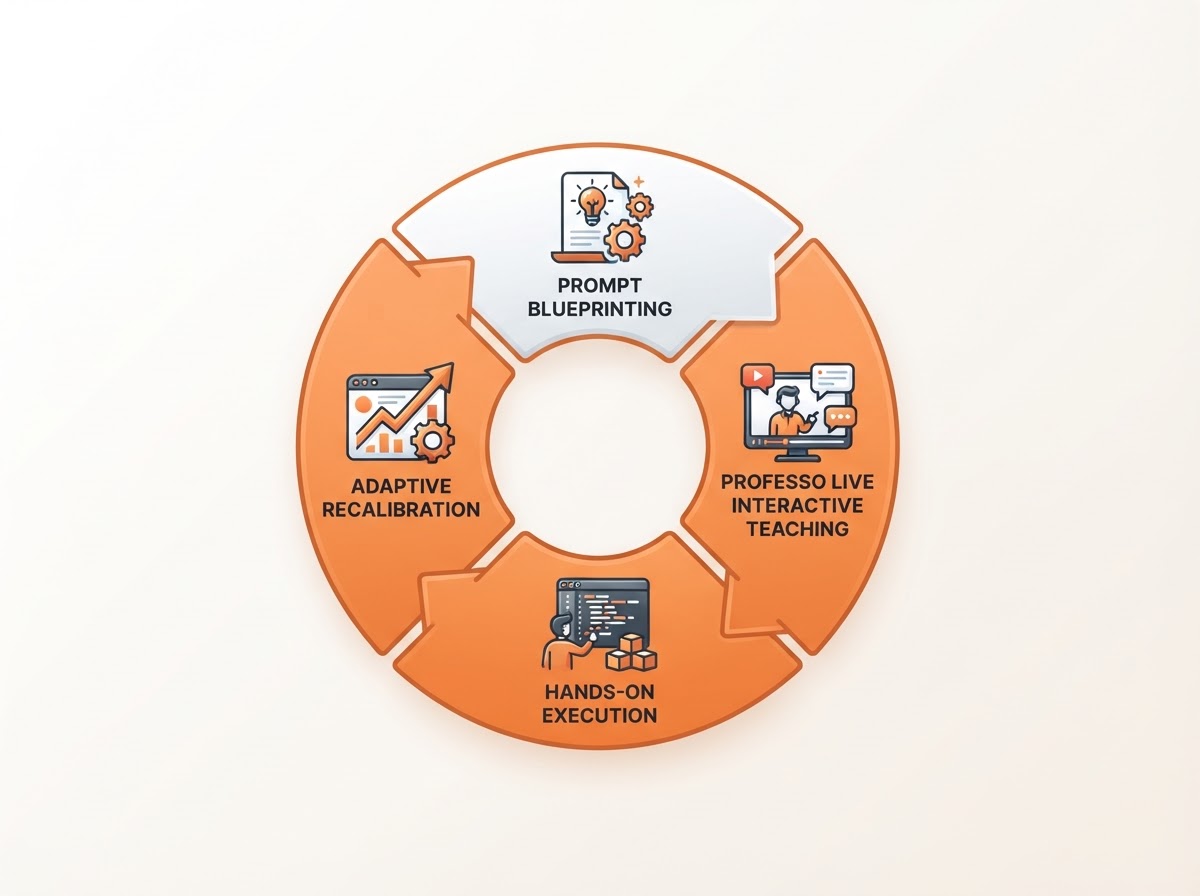
- Draft your baseline diagnostic prompt with your specific career goals, available hours per week, and current skill depth using advanced models like ChatGPT or Claude 3.5 Sonnet.
- Review the generated week-by-week competency roadmap, ensuring all foundational prerequisites are sequenced correctly before advanced applied modules.
- Import your personalized curriculum into Professo to experience live interactive whiteboard lessons, visual architecture breakdowns, and real-time voice Q&A.
- Execute hands-on project builds every week, using AI active recall testing and continuous adaptive path recalibration to eliminate knowledge gaps.
FAQ
How do I prompt ChatGPT to create a personalized technical learning roadmap?
To prompt ChatGPT effectively, provide your exact starting baseline, your target technical outcome, and your available study hours per week, while explicitly requesting a competency-sequenced milestone plan. You should instruct the model to include a diagnostic quiz at the beginning and specify hands-on project briefs for every module rather than passive reading assignments.
What AI tool can break down a complex subject into a week-by-week study plan?
Advanced large language models like Claude 3.5 Sonnet and ChatGPT excel at generating granular, week-by-week study plans when given strict structural constraints and competency dependency rules. For live execution and interactive visual breakdown of that study plan, platforms like Professo adapt the schedule in real time based on your performance.
Can AI create a customized learning path based on my specific background and hours per week?
Yes, generative AI models can tailor a complete learning path around your precise background, prior coding languages, and strict time constraints when explicitly instructed to do so in the prompt parameters. This eliminates superfluous foundational modules if you already possess relevant experience, maximizing your available study time.
Why isn't a static AI text prompt enough to master coding or technical skills?
Static AI text prompts only generate static outlines and code snippets, leaving learners to struggle through complex debugging, abstract architectural concepts, and knowledge gaps without real-time feedback. True technical mastery requires interactive execution, active recall testing, and visual demonstrations that static text generators cannot provide.
How does Professo differ from tools like Coursebox AI, Khanmigo, or ChatGPT?
While tools like Coursebox AI, Khanmigo, and ChatGPT rely primarily on static text generation, pre-rendered quizzes, or rigid chat interfaces, Professo acts as a live AI professor with an interactive whiteboard and real-time voice instruction. Professo enables you to interrupt lessons instantly for visual clarifications and dynamically adapts the curriculum on the fly during live sessions.
Next steps
Start Learning Today -> https://www.professoai.com/sign-up
AI-Personalized Learning Impact (%) — data: source